

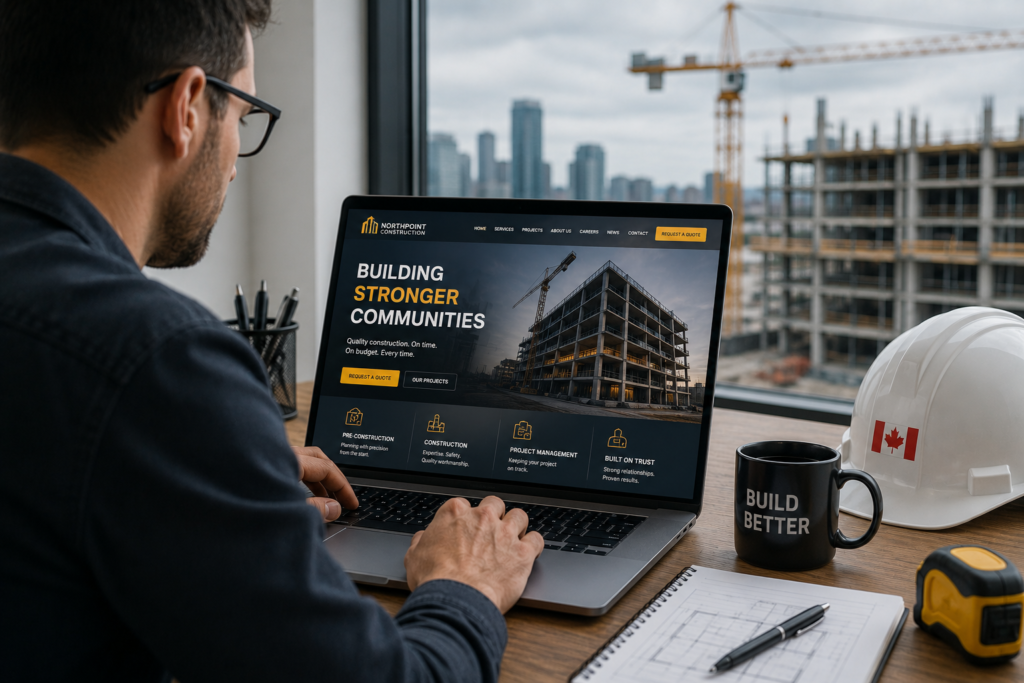
For a construction company, your website is often one of the first places a potential client will go before deciding whether to contact you.
They want to see more than a list of services. They want evidence that your company is professional, experienced, capable and trustworthy.
Whether you work in residential construction, commercial projects, renovations, general contracting or specialised construction services, a strong website should showcase the quality of your work and make it easy for prospective clients to take the next step.
Why Construction Companies Need a Professional Website
Construction is highly visual and trust-driven.
A prospective client may be considering a significant investment, so they’ll naturally want to know:
- What type of construction do you specialise in?
- What projects have you completed?
- Where do you operate?
- How experienced is your team?
- What does your construction process look like?
- How can they request a quote?
Your website should answer these questions before the prospect even contacts you.
A professional construction website essentially becomes your digital company profile, portfolio and lead-generation platform in one place.
Put Your Best Projects Front and Centre
Construction companies have something extremely valuable for website marketing:
Completed projects.
Use them.
High-quality photographs of your work can communicate your capabilities far more effectively than generic marketing claims.
Your portfolio might feature:
- Custom homes
- Commercial buildings
- Renovations
- Office fit-outs
- Extensions
- Multi-unit developments
- Industrial projects
- Retail construction
- Before-and-after transformations
Rather than creating a gallery containing dozens of unexplained photographs, consider creating individual project pages for your strongest work.
Turn Projects Into Case Studies
A project page can provide much more value than an image alone.
For example:
Commercial Office Renovation — Toronto
You could briefly explain:
Project: Commercial office renovation
Location: Toronto, Ontario
Scope: Interior renovation and fit-out
Services: Project management, construction and finishing
Then showcase professional project photographs.
This gives prospective clients context about the size and type of work your company handles.
Over time, your portfolio becomes powerful evidence of your experience.
Clearly Explain Your Construction Services
Don’t make potential clients guess what type of projects you accept.
Create clear sections for your major services.
Depending on the company, these might include:
Residential Construction
Custom homes, additions, renovations and residential developments.
Commercial Construction
Office, retail, hospitality and other commercial projects.
Renovations
Residential or commercial renovations and upgrades.
General Contracting
Construction coordination, subcontractor management and project delivery.
Project Management
Planning, coordination and oversight throughout the construction process.
Your website should reflect what your company actually provides rather than attempting to rank for every construction-related service imaginable.
Show Where You Work
Location matters greatly for construction companies.
If you serve Toronto and surrounding communities, make that clear.
If your company operates across Vancouver, Calgary, Edmonton, Ottawa or another region, state your actual coverage.
For example:
Providing residential and commercial construction services throughout Calgary and surrounding communities.
You can also create genuinely useful location pages when you have meaningful information or projects relevant to those areas.
Avoid mass-producing identical pages that simply replace one city name with another.
Build Trust With Real Information
Construction projects can involve significant budgets and long working relationships.
Your website should therefore make the company behind the work visible.
Consider including genuine information about:
- company history
- years of experience
- leadership team
- qualifications
- licences where applicable
- insurance information where appropriate
- industry memberships
- safety practices
- warranties
- customer testimonials
- completed projects
Don’t rely exclusively on statements like:
“Quality is our priority.”
Almost every construction company can say that.
Show the evidence.
Projects, testimonials, experience and professional credentials are far more convincing.
Explain Your Construction Process
Potential clients may have never hired a contractor for a major project before.
Explaining what happens after they contact you can remove uncertainty.
For example:
1. Initial Consultation
Discuss the project, objectives and basic requirements.
2. Site Assessment
Review the property and project conditions when required.
3. Scope & Proposal
Define the work and provide the appropriate proposal.
4. Planning
Coordinate schedules, materials, trades and other project requirements.
5. Construction
Complete the agreed work according to the project plan.
6. Completion
Finalise the project and complete the appropriate handover.
Your actual process may be different, so the website should reflect how your company genuinely works.
Make Requesting a Quote Simple
Don’t create a beautiful construction portfolio and then hide the contact button.
Calls to action should appear naturally throughout the website:
Request a Quote
Discuss Your Project
Book a Consultation
Contact Our Team
For larger construction projects, a slightly more detailed enquiry form can help qualify prospects.
Useful fields might include:
Name
Email
Phone
Project Location
Project Type
Estimated Timeline
Project Details
Only request information you genuinely need at that stage.
Design for Mobile Devices
Potential clients won’t always discover your company while sitting at a desktop computer.
They may receive your website from a referral, see one of your vehicles, discover your business through Google or visit your website after seeing a completed project.
Your construction website should therefore work properly across mobile devices.
Visitors should be able to:
view projects → understand services → read about your company → request a quote
without struggling with navigation or tiny text.
Don’t Overdesign the Website
Construction websites are particularly suited to strong visual design, but that doesn’t mean every section needs animations, videos and complicated effects.
Large project photography, strong typography and generous spacing can often communicate a much more premium image.
Let the projects breathe.
Instead of squeezing six projects, twelve icons and several paragraphs into one section, showcase your strongest work clearly.
For construction companies targeting premium projects, space and restraint can make the website feel significantly more established.
Create Content Around Your Expertise
Your construction website can also contain useful articles that answer questions prospective clients are already asking.
Examples might include:
What to Consider Before Starting a Commercial Renovation
Questions to Ask Before Hiring a General Contractor
How to Plan for a Home Renovation
What Happens During a Construction Consultation?
How to Choose a Construction Company for Your Project
Useful content can demonstrate expertise while giving search engines more context about your services.
Avoid publishing articles simply to fill a blog.
Each piece should have a genuine purpose for your prospective customers.
What Pages Should a Construction Company Website Have?
A straightforward construction website could include:
Home
About
Services
Projects
Our Process
Testimonials
Service Areas
Contact
Larger contractors may also need:
Industries
Safety
Careers
News / Insights
The exact structure should reflect the business rather than forcing every contractor into the same template.
Your Website Should Sell Your Capability
A construction company’s website doesn’t need to make exaggerated promises.
Your work should do much of the selling.
A strong website brings together:
professional design
- real projects
- clear services
- credible company information
- simple enquiries
When a potential client arrives, the website should leave them thinking:
“This company looks capable of handling my project.”
And the next step should be obvious.
Frequently Asked Questions
What should a construction company website include?
Most construction websites benefit from clear service information, completed projects, company information, testimonials, service areas and an easy way to request a consultation or quote.
Should construction companies have a project portfolio?
Yes. Construction is highly visual, and a portfolio allows prospective clients to see genuine examples of the type and quality of work your company completes.
Should each construction project have its own webpage?
Your strongest projects can benefit from individual case-study pages containing photographs, project information, location and scope. Smaller projects can still be grouped into galleries.
Should construction companies display pricing online?
Not necessarily. Construction projects can vary substantially in scope, materials, site conditions and requirements. Many companies are better suited to a consultation or quote-request process.
Can a construction website help generate leads?
A professional website can help potential customers discover your services, evaluate your work and contact the business. Its effectiveness will depend on factors including design, content, visibility, reputation and the overall customer journey.
Can a construction website help with Google visibility?
Clear service pages, useful content, location information and technically sound website structure can help search engines understand the business. Rankings depend on many factors and shouldn’t be guaranteed.
Looking for a Professional Construction Website?
Libetario has served 200+ clients worldwide since 2017.
If you’re a construction company looking for a professional website that showcases your projects, explains your capabilities and makes it easier for potential clients to enquire, tell us about your business.
We’ll help you determine the right website solution for your company.