
When travellers are choosing where to stay, your website can play a major role in whether they book with you—or continue looking elsewhere.
Guests may discover your hotel through Google, social media, travel platforms or a recommendation. But before making a reservation, many will still visit your website to see the rooms, explore amenities, check the location and understand what kind of experience you offer.
For hotels and resorts in Canada, a professional website should accomplish something very simple:
Inspire the guest. Build confidence. Make booking easy.
Why Hotels and Resorts Need a Professional Website
Hospitality is highly visual.
Potential guests want to imagine what staying at your property will actually feel like.
Before booking, they may want to know:
- What do the rooms look like?
- What room types are available?
- What amenities are included?
- Where is the property located?
- Is there a restaurant or breakfast?
- Is parking available?
- What attractions are nearby?
- How can they check availability?
- Can they book directly?
Your website should answer these questions while presenting the property in the best possible way.
Make Your Property the Hero
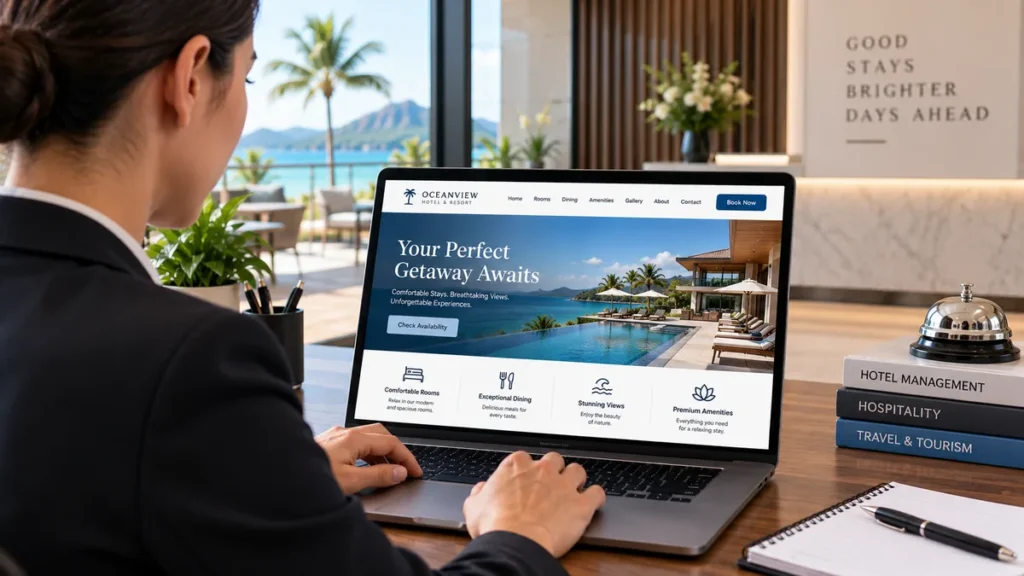
Your hotel website doesn’t need an overly complicated hero section.
Sometimes one exceptional photograph is enough.
Show your strongest visual asset:
the property
the view
the pool
the room
the surrounding landscape
Pair it with a concise message and a clear action such as:
Check Availability
or
Book Your Stay
The objective is to immediately give visitors a sense of the experience.
Showcase Rooms Properly
Your rooms are one of the main things guests are buying.
Don’t squeeze them into tiny cards with one photograph each.
Give every major room type enough space to communicate what makes it different.
A room page can include:
Professional photographs
Bed configuration
Maximum occupancy
Room size, when useful
Key amenities
View or location
Important inclusions
Check Availability button
Guests should be able to compare room options without confusion.
Invest in Professional Photography
For hospitality websites, photography isn’t decoration.
It’s part of the sales process.
Consider professional photographs of:
- Guest rooms
- Bathrooms
- Property exterior
- Pool
- Restaurant
- Lobby
- Views
- Common areas
- Amenities
- Surrounding destination
Avoid heavily editing photographs until they no longer accurately represent the property.
The goal is to make the hotel look exceptional while still setting realistic expectations.
Make Direct Booking Easy
Once a visitor decides they want to stay, don’t make them hunt for the booking button.
Use clear calls to action throughout the website:
Book Now
Check Availability
View Rooms
Reserve Your Stay
Your booking journey should work smoothly across desktop, tablet and mobile.
A visitor should be able to move naturally from:
Room → Availability → Dates → Guests → Reservation
with as little unnecessary friction as possible.
Explain Why Guests Should Book Direct
If you offer genuine benefits for booking through your own website, communicate them.
Depending on your property, these could include:
Best available direct rate
Flexible booking conditions
Complimentary inclusions
Special packages
Direct communication with the property
Only advertise benefits that you genuinely provide.
The goal isn’t to attack third-party booking platforms. Those platforms can be valuable distribution channels.
Your own website simply gives you an opportunity to build a direct relationship with the guest.
Sell the Experience, Not Just the Room
Guests aren’t always travelling simply because they need somewhere to sleep.
They may be planning:
a romantic getaway
a family holiday
a ski trip
a city break
a business trip
a wedding
a wellness retreat
an outdoor adventure
Your website can show what the overall stay feels like.
For a mountain resort, showcase the landscape and nearby activities.
For a city hotel, highlight convenience and nearby attractions.
For a luxury resort, emphasise the experience, service and amenities.
Make Amenities Easy to Understand
Guests shouldn’t have to email you to ask basic questions.
Clearly communicate relevant amenities such as:
Wi-Fi
Parking
Restaurant
Breakfast
Swimming pool
Fitness facilities
Spa
Pet policy
Accessibility features
Airport transfers, when available
Meeting or event facilities
Keep information accurate.
Few things frustrate travellers more than arriving with expectations created by outdated website information.
Use Your Location as a Selling Point
Your location can be one of your strongest marketing assets.
Instead of simply providing an address, help guests understand what’s nearby.
You might highlight:
Local attractions
Restaurants
Beaches
Ski areas
Shopping
Convention centres
National parks
Transport connections
Walking distances or travel times, when accurate
This is also an opportunity to create useful destination content that can support organic search visibility.
Make the Website Mobile First
Travellers frequently research and book accommodation from their phones.
Your mobile website needs to make the essential journey easy:
See property → View rooms → Check availability → Book
Avoid enormous pop-ups, complicated menus and buttons that are difficult to tap.
Important information such as check-in times, address, contact details and booking access should remain easy to find.
Don’t Overcrowd the Homepage
Hospitality websites benefit enormously from visual breathing room.
You don’t need to put:
12 rooms + 15 amenities + 8 promotions + 20 reviews + restaurant menu + destination guide
on the homepage.
A cleaner structure might be:
Hero
↓
Introduction
↓
Featured Rooms
↓
Experience / Amenities
↓
Destination
↓
Guest Reviews
↓
Book Your Stay
Let photography carry part of the message.
For hotels and resorts, generous spacing and large imagery can create a significantly more premium experience than squeezing everything together.
Showcase Genuine Guest Reviews
Guest feedback can strengthen confidence before someone books.
Feature selected genuine reviews where appropriate.
You can also provide links to established review platforms rather than attempting to reproduce every review on your own website.
The goal is to provide reassurance without overwhelming the page.
Create Content Around the Destination
Hotels have excellent opportunities for useful search content because guests aren’t only searching for accommodation.
They’re researching the destination itself.
Depending on your location, useful articles might include:
Best Things to Do in [Destination]
Where to Stay When Visiting [Destination]
A Weekend Guide to [Destination]
Best Time to Visit [Destination]
Family Activities Near [Hotel Location]
Restaurants Near [Hotel Location]
This content can introduce travellers to your property earlier in their trip-planning journey.
From there, internal links can naturally lead them toward rooms and booking pages.
What Pages Should a Hotel Website Have?
A clean hotel or resort website could include:
Home
Rooms / Accommodation
Amenities
Dining
Experiences
Gallery
Location / Destination
Offers
About
Contact
Book Now
Properties offering weddings, conferences, spas or other major services can add dedicated pages where appropriate.
The structure should reflect the actual guest experience.
Your Website Should Make Guests Want to Stay
A successful hotel website should guide visitors through a natural journey:
This property looks beautiful
↓
The rooms suit my trip
↓
It has the amenities I need
↓
The location works for me
↓
Other guests had a good experience
↓
Check availability
↓
Book
Everything—from photography and typography to page structure and booking functionality—should support that journey.
Your website isn’t simply an online brochure.
It’s part of the guest experience before the guest even arrives.
Frequently Asked Questions
What should a hotel website include?
A professional hotel website should clearly present rooms, amenities, location, photographs, policies, contact information and an easy way for guests to check availability or book.
Should every room type have its own page?
Major room categories can benefit from dedicated pages or detailed room sections containing photographs, occupancy, amenities and other information guests need when choosing accommodation.
Should hotels accept direct bookings through their website?
If the property’s systems support it, direct online booking can create a convenient guest experience and provide another reservation channel alongside third-party platforms.
Is professional photography important for hotel websites?
Yes. Accommodation is highly visual, and strong photography helps guests understand the property and imagine the experience before booking.
Can a hotel website help increase direct bookings?
A well-designed website can make direct booking easier and communicate benefits available through the property. Actual results depend on factors including rates, reputation, availability, marketing and competition.
Can hotel websites attract visitors through Google?
Useful destination content, accommodation pages, location information, structured website architecture and good technical implementation can support organic visibility. Search rankings depend on many factors and cannot be guaranteed.
Looking for a Professional Website for Your Hotel or Resort?
Libetario has served 200+ clients worldwide since 2017.
If you’re a Canadian hotel, resort or accommodation business looking for a professional website that showcases your property and makes it easier for guests to enquire or book, tell us about your business.
We’ll help you build the right online experience for your property.