

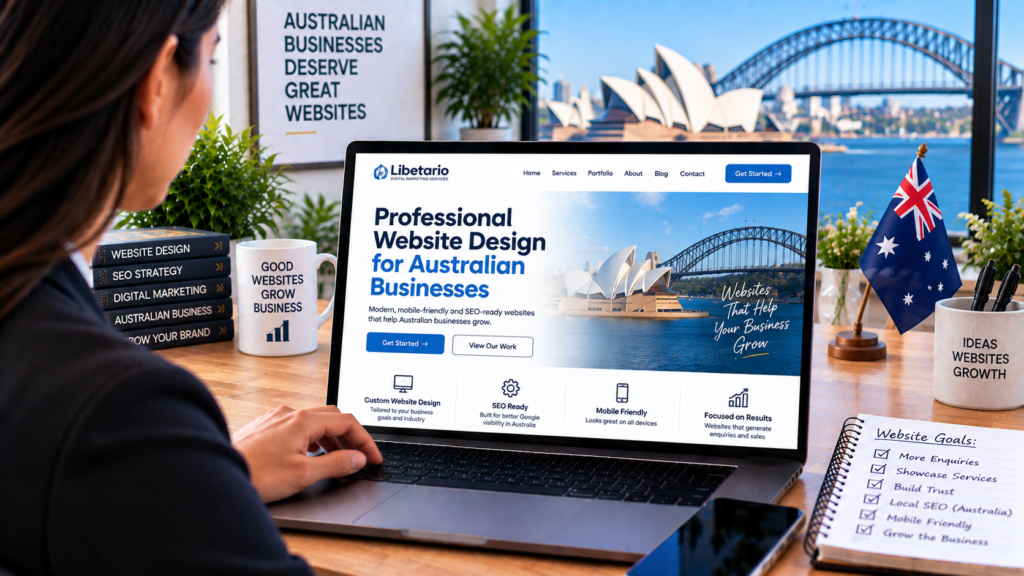
A professional website is no longer simply a place to display your business name, telephone number and list of services.
For Australian businesses, a website can play a much larger role.
Potential customers may discover your business through Google, compare you with competitors, read about your services, check your credibility and decide whether to contact you—all before speaking with anyone from your company.
That means professional website design in Australia should focus on more than appearance.
A good business website needs to help visitors:
Understand your business.
Find the service they need.
Trust your company.
Take the next step.
Whether that means requesting a quote, making an enquiry, booking an appointment or purchasing a product, your website should be designed around a genuine business objective.
Why Website Design Matters for Australian Businesses
Think about how you personally evaluate an unfamiliar company.
You search online.
You open its website.
Within seconds, you begin forming an impression.
Does the business appear professional?
Is the website current?
Can you understand what the company does?
Does it work properly on your phone?
Can you find the information you need?
Can you trust the business enough to make contact?
Your potential customers are doing the same thing.
A website may be one of the first significant interactions someone has with your brand.
That makes website design part of the customer experience—not simply a technical project.
What Should a Professional Business Website Include?
There isn’t one website structure suitable for every Australian business.
A plumber needs something different from an accountant.
A restaurant has different requirements from an e-commerce store.
However, most professional business websites need several fundamental elements.
Clear Business Message
Visitors should quickly understand:
What you do
Who you help
Where you operate, when location is relevant
What they should do next
Avoid opening your homepage with vague statements such as:
Welcome to our website.
Use that valuable space to communicate what your business actually offers.
Professional Visual Design
Good website design doesn’t mean filling every screen with effects.
Professional design often comes from consistency.
That includes:
Typography
Spacing
Colours
Photography
Buttons
Section layouts
Heading hierarchy
A clean website with generous spacing can often communicate more confidence than a crowded website trying to show everything at once.
Mobile-Friendly Design
Your customers aren’t only browsing from desktop computers.
They may discover your business from a smartphone while commuting, shopping, comparing providers or searching for a local service.
Your website should work properly across screen sizes.
Navigation should remain simple.
Text should remain readable.
Buttons should be easy to tap.
Forms shouldn’t become frustrating.
A mobile-friendly website isn’t an optional extra.
It should be part of the design from the beginning.
Your Website Should Be Built Around Customers
One of the biggest website-design mistakes is structuring the entire site around what the company wants to say.
Instead, think about what the visitor wants to know.
A potential customer may be asking:
Does this company provide what I need?
Do they work in my location?
How much experience do they have?
Can I see examples of their work?
What do other customers say?
How does their process work?
How do I get started?
Your website should answer those questions naturally.
That’s the difference between a website that simply exists and one designed to support business growth.
Make Your Services Easy to Find
If services generate your revenue, they shouldn’t be buried.
Give important services clear visibility.
For businesses with several major offerings, individual service pages can be particularly useful.
For example, an Australian air-conditioning company might have:
/air-conditioning-installation/
/air-conditioning-repairs/
/air-conditioning-maintenance/
/split-system-air-conditioning/
Rather than one generic page listing everything, each important service can properly explain:
What the service is
Who needs it
What the company provides
Relevant experience
Frequently asked questions
How to request a quote
This can improve both usability and the clarity of your website’s search structure.
Show Evidence, Not Just Marketing Claims
Almost every business can say:
Professional service.
High quality.
Trusted experts.
Customer focused.
Those statements alone don’t provide much evidence.
Show visitors why they should believe you.
Depending on your business, trust signals might include:
Customer reviews
Completed projects
Case studies
Client logos
Team members
Years of experience
Relevant licences or certifications
Industry memberships
Real business photography
Specific evidence is more persuasive than generic marketing language.
Use Genuine Photography Where Possible
Stock photography can be useful, particularly when a company is new.
But real images can make your website more distinctive.
Consider showing:
Your team
Your office
Your vehicles
Your products
Your projects
Your facilities
Your store
Your actual work
Australian customers researching a local business often want reassurance that there’s a genuine company behind the website.
Authentic photography can help establish that connection.
Website Design Should Support Google Visibility
A beautiful website that nobody discovers has limited marketing value.
That’s why search visibility should be considered during website planning.
A search-friendly website structure can include:
Clear page titles
Logical headings
Descriptive URLs
Individual service pages
Internal linking
Useful content
Image ALT text
Mobile usability
Fast-loading pages
Clear local information
However, professional website design alone doesn’t guarantee Google rankings.
Organic visibility also depends on competition, content, authority, links, relevance and many other factors.
The goal should be to create a technically sound foundation that can support a longer-term SEO strategy.
Think About Search Intent
Suppose someone searches:
website design Australia
That person may be looking for a company to create a website.
Someone searching:
how to design a website
may instead want to learn how to build one themselves.
Those are very different users.
Your website content should target the searches relevant to the customers you actually want.
For a service business, this could mean creating pages around:
Services
Industries
Customer problems
Locations
Commercial questions
Frequently asked questions
Your blog can then support those commercial pages with useful informational content.
Local Businesses Need Clear Location Information
If your business serves a particular Australian city or region, make that clear.
For example:
Residential and commercial electrical services across Brisbane and surrounding areas.
Visitors shouldn’t have to search the entire website to determine whether you serve their location.
Depending on the business, useful local information can include:
Service area
Physical address
Map
Opening hours
Telephone number
Directions
Parking information
Relevant local projects
This can also complement your Google Business Profile.
Don’t Create Hundreds of Empty Location Pages
Location targeting can be useful.
But simply duplicating one page dozens of times and replacing:
Sydney
with:
Melbourne
then:
Brisbane
isn’t a strong content strategy.
Location pages should contain genuinely relevant information.
If you operate in Sydney, your Sydney page should help Sydney customers.
If you don’t genuinely serve an area, don’t create a page simply because the keyword has search volume.
Quality and relevance should come first.
Your Website Needs a Clear Call to Action
What do you want visitors to do?
Possible actions include:
Get Started
Request a Quote
Book an Appointment
Call Now
Schedule a Consultation
Shop Online
Check Availability
Make an Enquiry
Choose the action that matches your business model.
Then make it obvious.
Don’t use ten different primary calls to action across the same page.
Visitors should understand the next step without having to think about it.
Keep Enquiry Forms Simple
Some websites ask for too much information too early.
A person wanting a quote shouldn’t necessarily have to complete 25 fields.
For many businesses, an initial form can begin with:
Name
Telephone
Service Required
Message
Additional information can be gathered after the initial contact.
Every unnecessary field can add friction.
Website Speed Matters
Large images, excessive animations and unnecessary software can slow down a website.
Website performance can be affected by:
Image file sizes
Hosting
Plugins
Third-party scripts
Fonts
Video backgrounds
Poorly optimised code
Tracking software
Optimise media before uploading it.
Use modern image formats such as WebP where appropriate.
A professional website should look good without forcing visitors to wait unnecessarily.
WordPress for Australian Business Websites
WordPress can be a strong option for businesses that want flexibility and room for future growth.
Depending on the project, a WordPress website can support:
Business websites
Blogs
E-commerce
Online booking
Membership functionality
Landing pages
Service pages
Location pages
Custom integrations
Content marketing
The platform itself, however, doesn’t determine whether the website will succeed.
Design quality, development, content, hosting, maintenance and marketing all matter.
Choose technology based on what the business needs rather than simply following trends.
Should Australian Businesses Use DIY Website Builders?
DIY website builders can make sense for some businesses.
A very small business with a limited budget and straightforward requirements may prefer to build its first website independently.
The decision changes when the business needs more from the website.
For example:
Custom branding
Professional conversion structure
Advanced SEO
Custom functionality
Integrations
E-commerce
Booking systems
Long-term content marketing
Scalability
The important question isn’t:
“Can I build a website myself?”
It’s:
“What does my business need this website to accomplish?”
How Much Does Website Design Cost in Australia?
There isn’t one universal website-design price.
Cost can vary depending on:
Number of pages
Design requirements
Content
E-commerce functionality
Booking systems
Custom development
Integrations
Database requirements
SEO requirements
Ongoing support
A straightforward five-page business website and a custom e-commerce platform are fundamentally different projects.
When comparing quotes, don’t compare only the final price.
Compare what is actually included.
Questions to Ask a Website Designer
Before choosing a website designer or web design company, consider asking:
What is included in the project?
How many pages are included?
Will the website work properly on mobile?
Who provides the content?
Is basic SEO setup included?
Who owns the website?
What happens after launch?
Are there recurring fees?
Can the website be expanded later?
What isn’t included?
A clear scope can prevent misunderstandings later.
Watch for Unclear Ongoing Costs
Before approving a website project, understand both:
Initial cost
and
Ongoing cost
Depending on the provider and platform, recurring expenses might include:
Hosting
Domain renewal
Premium plugins
Software subscriptions
Maintenance
Support plans
Booking systems
E-commerce applications
There’s nothing inherently wrong with recurring costs when they provide genuine value.
The important thing is that they’re transparent.
Build for the Business You Want to Become
Your website should solve today’s requirements while allowing reasonable room for tomorrow.
You may currently need:
Home
About
Services
Contact
But over time, you might add:
More services
Locations
Blog content
Online payments
Bookings
E-commerce
Case studies
Customer portals
CRM integrations
Marketing automation
Planning for growth can reduce the likelihood of rebuilding everything from scratch later.
What Pages Should an Australian Business Website Have?
A typical small-business website might include:
Home
About
Services
Individual Service Pages
Projects / Portfolio
Reviews
Blog / Resources
Contact
Depending on the business, you may also need:
Locations
Bookings
Shop
FAQs
Team
Case Studies
Privacy Policy
Terms
There is no advantage in adding unnecessary pages simply to make a website look bigger.
Every page should have a purpose.
What Makes Good Website Design in Australia?
Good website design isn’t about following one visual trend.
It’s about bringing several elements together:
Clear messaging
Professional design
Mobile usability
Strong website structure
Useful content
Trust signals
Fast performance
Search-friendly foundations
Clear calls to action
Most importantly, the website needs to make sense for the business and its customers.
A local trades company, professional consultancy, restaurant and online store shouldn’t all have the same website.
Good design begins with understanding the business.
Frequently Asked Questions
What should I look for in a website design company in Australia?
Look at the company’s previous work, project scope, communication, platform, mobile approach, SEO foundations, ownership terms, support arrangements and all initial and recurring costs.
How many pages does a small business website need?
There is no fixed number. A straightforward business may begin with five core pages, while businesses with several services, locations or products may need considerably more.
Is WordPress suitable for Australian small businesses?
WordPress can suit many small businesses because it supports a wide range of website types and can be expanded over time. The appropriate platform still depends on the project’s requirements.
Does a professional website help with Google rankings?
A properly structured website can provide a stronger foundation for SEO, but professional design alone doesn’t guarantee rankings. Content, relevance, competition, authority and technical factors also matter.
Should my Australian business website have a blog?
If organic search is part of your marketing strategy, a blog can help you publish useful content around questions and topics potential customers search for.
Can a website generate business enquiries?
A website can help visitors discover your company, understand your services, build confidence and make contact. Actual enquiry volume depends on traffic, demand, competition, reputation, offer and marketing.
Looking for Professional Website Design for Your Australian Business?
Libetario has served 200+ clients worldwide since 2017.
We create professional websites for businesses that want a clean, modern online presence built around their services and customers.
Whether you’re starting a new business, replacing an outdated website or planning a more capable online presence, tell us what you need.
We’ll help you determine the right website solution for your business.