

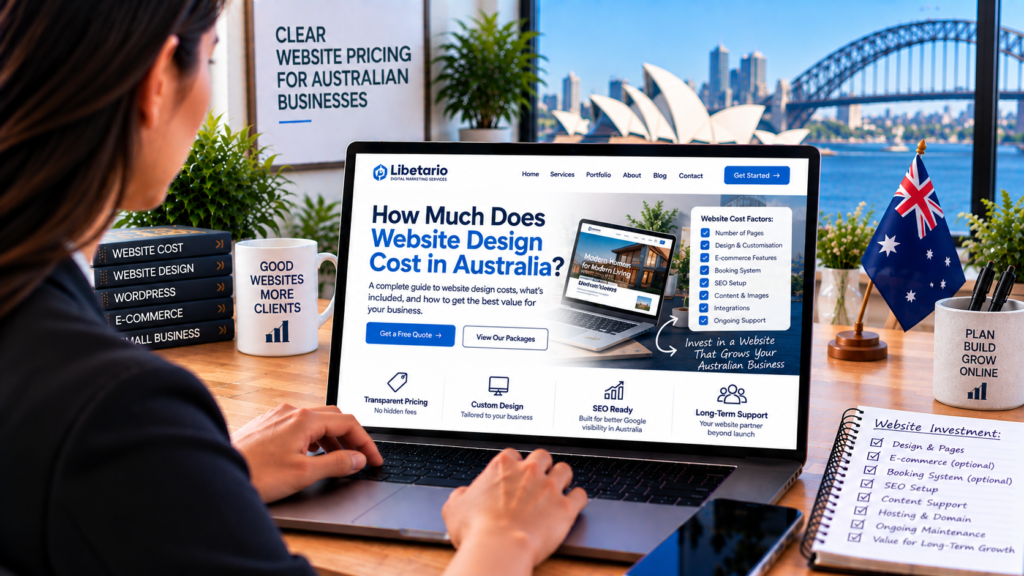
One of the first questions Australian business owners ask when planning a new website is simple:
How much does website design cost in Australia?
Unfortunately, there isn’t one price that applies to every website.
A five-page website for a local service business is very different from an ecommerce store with hundreds of products.
A website requiring online bookings is different from one requiring only a contact form.
And a custom business platform with databases, customer accounts and external integrations is a completely different development project again.
Instead of asking only:
“How much does a website cost?”
a better question is:
“What does my business actually need the website to do?”
Once that’s clear, website quotes become much easier to understand and compare.
Why Website Design Prices Vary So Much
You may request quotes from several website designers and receive dramatically different prices.
That doesn’t necessarily mean one company is overcharging or another is offering an incredible bargain.
They may be quoting completely different scopes.
Website cost can be influenced by:
Number of pages
Design complexity
Content creation
Platform
Ecommerce
Booking functionality
Forms
SEO requirements
Custom development
Integrations
Product uploads
Database functionality
Hosting
Maintenance
Support
Two websites can look similar from the outside while requiring very different amounts of work behind the scenes.
Start With the Type of Website You Need
Before discussing price, identify the general type of website.
Small Business Website
A typical small-business website might include:
Home
About
Services
Projects or Reviews
Contact
Its primary purpose may be generating enquiries.
Professional Service Website
An accountant, consultant, lawyer or similar business may need:
Multiple service pages
Team profiles
Resources
Case studies
Appointment booking
Lead-generation forms
Ecommerce Website
An online store may require:
Products
Categories
Shopping cart
Checkout
Payments
Shipping
Customer accounts
Inventory
Booking Website
Accommodation, clinics, salons and other businesses may require:
Availability
Appointments
Payments
Notifications
Calendar management
Custom Website or Web System
More specialised businesses may require:
Customer portals
Databases
Dashboards
API integrations
Automated workflows
Custom business logic
These aren’t comparable projects.
How Much Does a Basic Business Website Cost?
There is no official Australian standard price for a basic website.
Providers use different pricing models.
Some charge a one-time project fee.
Some use monthly subscriptions.
Some combine setup fees with recurring costs.
Some provide predefined packages.
Others quote each project individually.
Instead of relying on an arbitrary average, request a written scope explaining exactly what the quoted price includes.
A basic website quote should clarify things such as:
Number of pages
Design
Mobile optimisation
Forms
Content
SEO setup
Hosting
Domain
Revisions
Support
Ownership
Without this information, comparing prices isn’t particularly meaningful.
Number of Pages Affects Cost
Page count is one of the easiest differences to understand.
A one-page website generally requires less work than a 20-page website.
But page count isn’t the only factor.
Five completely custom pages can require more work than ten pages using a consistent structure.
When requesting a quote, prepare a rough sitemap.
For example:
Home
About
Services
Service 1
Service 2
Service 3
Projects
Blog
Contact
This allows providers to quote against a clearer scope.
Custom Design Can Affect Pricing
Website design exists on a spectrum.
At one end, a provider may use a standard template with relatively minor modifications.
At the other, a website may involve:
Custom page layouts
Detailed brand direction
Custom illustrations
Unique interactions
Advanced animation
Original design systems
Extensive UX planning
Neither approach is automatically right or wrong.
A small local business may not require an expensive bespoke design process.
A larger brand with specific requirements may.
The appropriate level of customisation should match the project.
Content Can Be a Separate Cost
Someone has to write the website.
Sometimes the client provides all text.
Sometimes the web designer helps structure existing material.
Sometimes professional copywriting is included.
Sometimes it is a separate service.
Ask whether the quote includes:
Page copy
Editing
SEO-focused content
Product descriptions
Blog content
Image sourcing
Content upload
If you’re providing content yourself, organise it before development where possible.
Good preparation can make the project much more efficient.
Photography and Visual Assets Matter
A professional website needs appropriate visual material.
This could come from:
Existing company photography
Professional photography
Stock images
Product photography
Illustrations
Graphics
Video
Custom photography and video can increase project costs, but they may also substantially improve the final website.
Ask whether visual assets are included or need to be supplied separately.
Ecommerce Websites Usually Cost More
An ecommerce website does more than display information.
It processes transactions.
That introduces additional requirements such as:
Products
Variations
Payments
Shipping
Tax configuration
Order management
Customer accounts
Emails
Inventory
Coupons
Returns workflows
A store with 15 simple products may be relatively straightforward.
A store with thousands of SKUs, multiple warehouses and external integrations is not.
This is why ecommerce website pricing varies considerably.
Product Entry Can Affect Ecommerce Cost
If you have hundreds of products, someone needs to enter or import them.
Each product may require:
Title
Description
Price
Images
SKU
Category
Variations
Dimensions
Stock
Shipping information
Clarify whether product entry is included and how many products the quoted price covers.
Booking Systems Can Add Complexity
A website that accepts bookings may require much more than a calendar.
Consider whether you need:
Real-time availability
Multiple staff
Multiple locations
Service durations
Online payments
Deposits
Email reminders
SMS
Cancellation rules
Calendar synchronisation
Third-party booking integrations
The more complicated the workflow, the more planning and development may be required.
Integrations Can Change the Project Scope
Businesses increasingly want their website connected with other systems.
Examples include:
CRM
Email marketing
Accounting software
Property systems
Payment gateways
Shipping providers
Booking platforms
External APIs
Marketing automation
An integration may be straightforward if the third-party service provides good documentation and supported tools.
Others may require custom development.
Never assume an integration is simple until the technical requirements have been reviewed.
WordPress Website Costs
WordPress itself is open-source software, but that doesn’t mean a professional WordPress website has no cost.
You may still need:
Design
Development
Hosting
Domain
Premium themes
Premium plugins
Security
Backups
Maintenance
Customisation
Content
SEO
WordPress can be cost-effective because many common website requirements don’t need to be developed entirely from scratch.
But the quality of implementation still matters.
Website Builders and Subscription Pricing
Hosted website builders often use subscription pricing.
This can make the initial cost appear lower because you aren’t necessarily paying a large development fee upfront.
However, consider the longer-term cost.
For example, ask:
What is the monthly or annual fee?
What features are included?
Does the price increase with additional functionality?
Are ecommerce fees separate?
Can the website be moved elsewhere?
What happens if the subscription ends?
A lower upfront cost doesn’t automatically mean a lower total cost.
One-Time Cost vs Monthly Website Plans
Website companies can use very different business models.
One-Time Project Fee
You pay for design and development as a project.
There may still be recurring expenses for:
Hosting
Domain
Software
Maintenance
Monthly Website Plan
You pay an ongoing subscription that may combine:
Website
Hosting
Maintenance
Support
Software
Hybrid Model
You pay an initial development fee plus ongoing service costs.
None of these models is automatically bad.
What matters is understanding exactly what you’re paying for.
Ask About Website Ownership
This is particularly important when comparing inexpensive website packages.
Ask:
Do I own the website after paying for it?
Who owns the domain?
Who controls hosting?
Will I receive administrative access?
Can I move the website to another provider?
What happens if I cancel?
Are any parts licensed rather than owned?
A low price may be less attractive if the business has no control over its website.
Domain Costs
Your domain is your website address.
Examples include:
yourbusiness.com.au
or:
yourbusiness.com
Domains usually involve recurring registration or renewal costs.
The exact amount depends on the domain extension and registrar.
Ideally, the business should understand who controls the domain account.
Losing access to a business domain can create serious problems.
Hosting Costs
Hosting provides the server environment where the website operates.
Hosting prices vary according to:
Resources
Performance
Support
Backups
Security
Traffic
Storage
Server configuration
A small informational website doesn’t necessarily require expensive enterprise hosting.
An ecommerce store receiving substantial traffic may need more resources.
Choose hosting appropriate for the project.
Premium Plugins and Software
Some website functionality depends on commercial software.
Examples may include:
Page builders
Booking systems
Ecommerce extensions
Form tools
Security software
Backup services
Membership systems
Translation tools
SEO software
These may have annual or monthly licences.
Ask which licences are included and who is responsible for renewing them.
SEO Costs Are Different From Website Design Costs
A website can be built with basic SEO foundations.
That may include:
Page titles
Meta descriptions
Heading structure
URLs
Image ALT text
Sitemap
Mobile compatibility
Performance basics
But an ongoing SEO campaign is a different service.
It may involve:
Keyword research
Content production
Competitor research
Technical SEO
Local SEO
Link acquisition
Reporting
Ongoing optimisation
Don’t assume that purchasing a website automatically includes months of SEO work.
Ask what “SEO included” actually means.
Cheap Website vs Affordable Website
These terms shouldn’t necessarily mean the same thing.
A cheap website is simply inexpensive.
An affordable website provides the functionality the business needs at a sensible cost.
A lower-priced website can still be excellent when:
The scope is simple
The process is efficient
The technology is appropriate
The client provides content
Unnecessary features are avoided
Likewise, an expensive website isn’t automatically better.
Judge value by what the business receives.
Why Extremely Low Prices Deserve Investigation
If one quote is dramatically cheaper than every other provider, ask why.
The package may exclude:
Mobile optimisation
Content
SEO setup
Hosting
Forms
Revisions
Support
Premium licences
Website ownership
Or the website may rely on a subscription that creates ongoing costs.
This doesn’t automatically make the offer bad.
It simply means you need to understand it.
Why Expensive Quotes Also Need Investigation
A high price doesn’t guarantee a better website.
Ask the provider to explain:
What work is being performed?
What is custom?
What functionality is included?
What strategy is included?
Who is working on the project?
What support is provided?
What measurable deliverables will you receive?
The objective is not to find the cheapest provider.
It’s to understand value.
How to Compare Website Quotes Properly
Instead of placing three final prices side by side, create a comparison based on scope.
Compare:
Pages
Design
Mobile optimisation
Content
SEO
Forms
Functionality
Hosting
Domain
Licences
Revisions
Support
Ownership
Ongoing fees
Only then can you understand whether the quotes are genuinely comparable.
Can an Overseas Web Designer Reduce Costs?
Australian businesses aren’t limited to providers physically located in Australia.
Remote web design has made it possible to work with providers around the world.
An overseas provider may have different operating costs.
However, price shouldn’t be the only consideration.
Evaluate:
Portfolio
Communication
Understanding of your market
Project management
Technical capability
Availability
Support
Ownership terms
Client reviews
Pricing transparency
A good remote relationship can work extremely well when expectations are clear.
Don’t Forget the Cost of Your Own Time
Website projects require client involvement.
You may need to provide:
Content
Feedback
Images
Product information
Approvals
Business information
Integration access
Policies
If these materials are disorganised, projects can take longer.
Preparing your content before development can reduce delays and make the process more efficient.
Should You Build the Website Yourself?
DIY website builders can reduce upfront development costs.
For some very small businesses, that may be a reasonable option.
But consider the value of your own time.
If you spend 80 hours learning website design, troubleshooting mobile layouts and configuring forms, what could those 80 hours have been worth inside your business?
DIY can be inexpensive financially but expensive in time.
The right decision depends on your situation.
How to Reduce Website Design Costs
If budget is limited, you can keep the project focused.
Consider:
Start with essential pages
Provide organised content
Provide your own branding
Provide quality images
Avoid unnecessary functionality
Use established platforms
Combine revision feedback
Plan future features for later phases
For example, you may launch with five pages now and add additional service pages over time.
You don’t need to build the entire future of the business on day one.
Invest More Where It Matters
If your budget is limited, prioritise the parts customers actually experience.
These often include:
Homepage
Service pages
Mobile experience
Calls to action
Contact process
Photography
Website speed
Trust signals
Core SEO structure
You can always add more advanced features later.
Consider the Website’s Long-Term Value
A website shouldn’t be evaluated only as an expense.
Suppose a professional website helps generate enquiries consistently over several years.
Its business value may greatly exceed the original development cost.
This doesn’t mean every expensive website produces results.
It means website investment should be considered in relation to what the website is expected to accomplish.
For a lead-generation business, ask:
How valuable is one new customer?
That can put website cost into perspective.
Plan for Future Growth
Your website may begin simply.
But later you could need:
More service pages
Blog content
Additional locations
Bookings
Online payments
Ecommerce
CRM integration
Customer portals
Automation
Custom databases
Discuss likely future requirements before choosing the initial platform.
Sometimes paying slightly more for a flexible foundation can reduce future rebuilding costs.
What Should Be Included in a Website Quote?
A useful website proposal should clearly identify:
Project scope
Number of pages
Design approach
Functionality
Content responsibilities
SEO inclusions
Revisions
Timeline
Hosting
Domain
Licences
Support
Payment terms
Ongoing costs
Ownership
The clearer the scope, the easier it is for both sides to manage expectations.
Questions to Ask Before Paying for a Website
Before approving a project, ask:
What’s included in the quoted price?
What isn’t included?
How many pages will I receive?
How many revisions are included?
Who provides content?
Is mobile optimisation included?
What SEO work is included?
Are there recurring fees?
Who owns the website?
Who owns the domain?
Can the website be transferred?
What support is provided after launch?
These questions can prevent expensive surprises.
Frequently Asked Questions
How much does a small business website cost in Australia?
There is no universal price. Cost depends on the number of pages, design, content, functionality, provider, platform and support requirements. Request a detailed quote based on your actual business needs.
Why do website design quotes vary so much?
Different providers may include different levels of design, content, SEO, functionality, support and customisation. Compare the scope rather than only comparing the final price.
Is WordPress expensive?
WordPress itself is open-source, but professional WordPress websites can involve design, development, hosting, premium software, maintenance and other costs.
Is ecommerce website design more expensive?
It often requires more work because ecommerce websites may involve products, payments, checkout, shipping, inventory and integrations. Complexity varies significantly between stores.
Do websites have ongoing costs?
Usually there are at least some recurring costs, such as domain renewal and hosting. Depending on the website, there may also be software licences, maintenance, ecommerce applications or other services.
Do I have to pay monthly for website design?
Not necessarily. Some providers charge a one-time project fee, others use subscriptions, and some combine both. Ask the provider to explain all ongoing charges.
Should I choose the cheapest website designer?
Price should be one consideration, but also evaluate scope, portfolio, ownership, communication, functionality, support and long-term costs.
Looking for a Professional Website Without Unnecessary Costs?
Libetario has served 200+ clients worldwide since 2017.
We believe businesses should understand what they’re paying for.
Rather than adding unnecessary functionality, a website project should be based on what your business actually needs today while allowing reasonable room for future growth.
If you’re an Australian business planning a new website, replacing an outdated site or comparing website-design quotes, tell us about your requirements.
We’ll help you identify the right website solution for your business.