A website is often one of the first places potential customers encounter your business.
Someone searching Google for a builder, electrician, heat pump installer, accountant, accommodation provider, healthcare practice or another New Zealand business may compare several companies before making contact.
They’ll look at your services, reviews, previous work and overall professionalism.
Within minutes—or sometimes seconds—they begin deciding which company they trust.
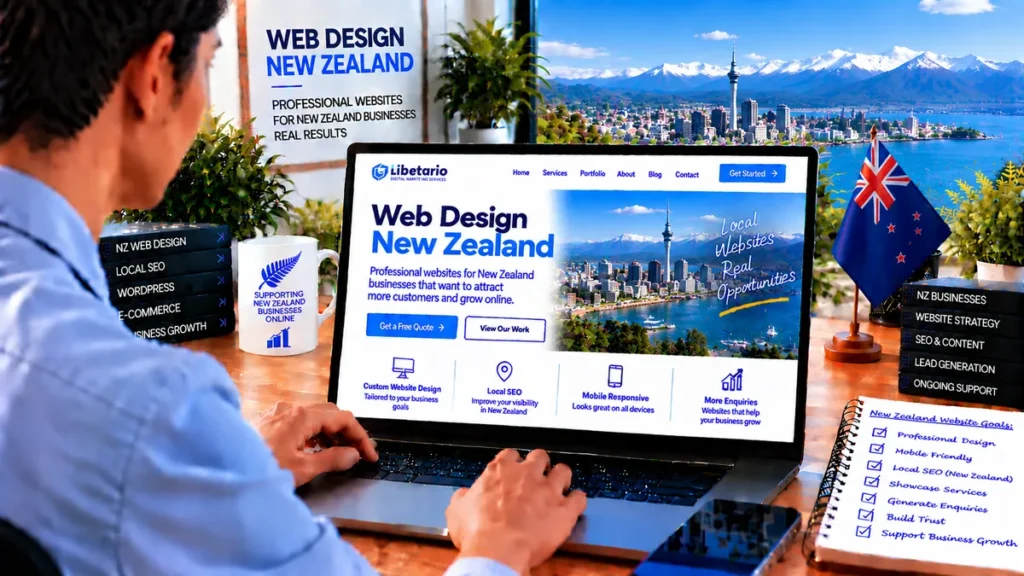
That’s why professional web design in New Zealand should be about more than creating an attractive website.
A good business website should clearly explain what you offer, establish credibility and guide potential customers towards taking action.
That might mean:
Request a Quote
Call Now
Book a Consultation
Make an Enquiry
Book Online
Shop Online
Your website shouldn’t simply exist. It should have a job to do.
What Makes a Good New Zealand Business Website?
Good website design starts with understanding the customer.
Imagine someone has found your company through Google for the first time.
They may immediately want to know:
What does this company do?
Do they provide the service I need?
Do they service my location?
Can I trust them?
How do I contact them?
Your website should answer these questions without forcing visitors to search through multiple pages.
A strong homepage will usually introduce the business, highlight important services, provide evidence of credibility and offer a clear next step.
For example, instead of a vague headline such as:
Innovative Solutions for a Better Tomorrow
a heat pump business could say:
Heat Pump Installation & Servicing for Auckland Homes and Businesses
The second version immediately tells the customer what the company does and where it operates.
Clarity beats clever wording.
Web Design Should Be Built Around Your Business Goal
Before choosing colours, animations or layouts, decide what the website should achieve.
A New Zealand trade business may want:
Quote requests
A healthcare practice may want:
Online appointments
A professional firm may want:
Consultation bookings
An accommodation provider may want:
Direct reservations
An ecommerce company may want:
Online purchases
These goals should influence the entire website.
For a service business, for example, Get a Quote might appear in the header, hero section, service pages and final call-to-action.
The website should naturally move visitors towards the next step.
Different NZ Businesses Need Different Websites
There is no single website structure that works for every business.
A builder and an accountant shouldn’t have identical websites.
Neither should a heat pump installer and a hotel.
New Zealand businesses may operate in:
Trades
Construction
Heat pumps and HVAC
Professional services
Healthcare
Property
Agriculture
Tourism
Hospitality
Retail
Ecommerce
B2B services
Each industry has a different customer journey.
A builder may need project galleries and detailed service pages.
An accountant may need team profiles, expertise and resources.
An accommodation provider may need rooms, galleries, availability and online bookings.
Professional web design starts with the business rather than forcing every company into the same template.
Web Design for New Zealand Tradies
For electricians, builders, plumbers, HVAC companies, landscapers and other trades, the website’s main objective is often simple:
Generate qualified enquiries.
Potential customers generally want to know:
- What services do you provide?
- Which locations do you service?
- Are you qualified and experienced?
- Can I see examples of your work?
- What do previous customers say?
- How can I request a quote?
A trade website doesn’t need complicated animations to answer these questions.
It needs clear information and strong trust signals.
Real project photographs, customer reviews, licences, qualifications, service areas and straightforward contact options can be much more valuable than decorative effects.
Give Important Services Their Own Pages
One of the most important decisions in website structure is how services are organised.
Imagine a New Zealand heat pump company provides:
Heat Pump Installation
Heat Pump Repairs
Heat Pump Servicing
High Wall Systems
Ducted Heat Pumps
Commercial HVAC
Instead of describing everything briefly on one Services page, major services can have dedicated pages.
For example:
/heat-pump-installation/
That page can explain the installation process, available systems, suitable properties, frequently asked questions, previous installations and how to request a quote.
This is useful for customers and creates a much clearer topic for search engines.
The same strategy applies to builders, electricians, accountants, healthcare providers and many other businesses.
Build Your Website Around Valuable Services
Not every service needs equal prominence.
Consider:
Which services generate our best customers?
Which work is most profitable?
What services do we want more enquiries for?
What differentiates us from competitors?
Your website structure should support those priorities.
If heat pump installation is far more commercially important than maintenance, it may deserve greater prominence on the homepage.
If commercial construction is your growth target, don’t bury it at the bottom of a generic Services page.
Your website should support where your business wants to go.
Use Real Projects to Build Trust
One of the strongest ways to establish credibility is to show actual work.
This is particularly useful for:
Builders
Electricians
HVAC companies
Landscapers
Interior designers
Property businesses
B2B companies
Instead of saying:
We Deliver Exceptional Quality
prove it.
A project page might show:
Location
Customer requirement
Scope of work
Challenges
Solution
Before-and-after images
Finished result
Customer feedback
For example:
Heat Pump Installation in Tauranga
or:
Home Renovation Project in Christchurch
Project content helps potential customers evaluate your experience while also adding genuine local relevance to your website.
Local SEO Matters for New Zealand Businesses
If you provide services within a specific area, your website should communicate that clearly.
Depending on your business, this could include:
Auckland
Christchurch
Wellington
Hamilton
Tauranga
Dunedin
Palmerston North
Napier
Rotorua
New Plymouth
But simply repeating city names isn’t good local SEO.
Instead, demonstrate genuine relevance through:
Real service areas
Local projects
Customer examples
Google Business Profile
Accurate business information
Location-specific content
Useful local articles
Only target locations where you genuinely provide services.
Should Your Business Have Location Pages?
If your company serves several important areas, location pages can be useful.
For example:
/web-design-auckland/
/web-design-christchurch/
/web-design-wellington/
A strong location page shouldn’t simply copy another page and replace the city name.
It should provide genuinely useful information.
That may include:
Services available
Local business needs
Relevant projects
Customer examples
FAQs
Contact options
Quality matters more than producing hundreds of nearly identical pages.
This is also the strategy we’ll use throughout our own New Zealand SEO campaign: each major search intent deserves useful, dedicated content.
Your Website Must Work Properly on Mobile
Many customers will discover your business from their phone.
They may be at home, travelling, on a job site or comparing several providers.
A mobile website should make it easy to:
Understand what you do
View services
Read reviews
See previous work
Call
Request a quote
Book
Purchase
Buttons should be easy to tap.
Text should be readable without zooming.
Forms shouldn’t be frustrating to complete.
For businesses that depend heavily on telephone enquiries, a visible Call Now button can make contacting the company much easier.
Mobile design isn’t an optional extra anymore. It should be considered from the beginning.
Website Speed Is Part of the Customer Experience
An attractive website isn’t particularly useful if visitors become frustrated waiting for it to load.
Common causes of slow websites include:
Oversized images
Large background videos
Poor hosting
Too many plugins
Third-party scripts
Unnecessary fonts
Poor caching
Images should generally be resized and compressed before being uploaded.
Modern formats such as WebP can also help reduce image file sizes while maintaining suitable visual quality.
Performance should be considered during development rather than treated as something to fix later.
Build Trust Throughout the Website
Someone finding your company through Google may have never heard of you before.
Your website needs to reduce uncertainty.
Trust signals can include:
Customer reviews
Completed projects
Team profiles
Qualifications
Licences
Certifications
Professional memberships
Years of experience
Client logos
Real business photography
Clear contact information
Don’t place every trust signal on the About page.
For example, customer reviews might appear beside services, project examples can appear on the homepage and qualifications can be displayed near relevant calls-to-action.
Trust should be built throughout the customer journey.
Content Should Answer Real Customer Questions
Blogging can support SEO, but publishing random articles isn’t a strategy.
Focus on questions potential customers genuinely ask.
For example, a heat pump company might publish:
How Much Does Heat Pump Installation Cost in NZ?
A builder might publish:
How Much Does a Home Renovation Cost in New Zealand?
An electrician could write:
How Much Does a Switchboard Upgrade Cost in NZ?
These topics can reach customers while they’re researching a purchase.
The article can then guide them towards a commercial page:
Heat Pump Cost Guide
↓
Heat Pump Installation
↓
Recent Installation Project
↓
Request a Quote
This gives informational content a business purpose.
Is WordPress Suitable for New Zealand Businesses?
WordPress can be suitable for many New Zealand businesses because it can support everything from simple service websites to more advanced functionality.
It can be used for:
Business websites
Trade websites
Professional services
Blogs
Portfolios
Property websites
Accommodation
Online bookings
Ecommerce
Memberships
Custom integrations
It also allows websites to expand as businesses grow.
However, WordPress still requires proper hosting, updates, security, backups and performance optimisation.
Choosing the platform is only one part of creating a successful website.
Ecommerce Website Design in New Zealand
Businesses selling online have additional requirements.
A successful ecommerce website may need:
Product categories
Search and filters
Product variations
Secure checkout
Payment processing
Shipping options
Inventory management
Customer accounts
Order notifications
The entire purchasing journey should work comfortably on mobile devices.
The goal isn’t simply to display products.
It’s to remove unnecessary friction between product discovery and payment.
How Much Does Web Design Cost in New Zealand?
There isn’t one standard price for professional website design in New Zealand.
Pricing depends on factors such as:
Number of pages
Design requirements
Content
Ecommerce
Bookings
Custom functionality
Integrations
SEO requirements
Ongoing support
A straightforward five-page business website and a large ecommerce platform are completely different projects.
When comparing providers, look beyond the advertised starting price.
Understand exactly what’s included.
Check Ongoing Website Costs
It’s also important to understand what happens after launch.
Potential ongoing expenses may include:
Domain renewal
Hosting
Premium software
Booking systems
Ecommerce applications
Maintenance
Security
Business email
Third-party integrations
Ask providers to explain both the initial project cost and any ongoing charges.
This makes comparing website proposals much easier.
Do You Need a New Zealand-Based Web Designer?
Not necessarily.
New Zealand businesses can work with local agencies, freelancers, remote providers or international web design teams.
Website projects can now be managed through:
Video meetings
Messaging
Online project management
Cloud collaboration
Rather than choosing purely by location, compare:
Portfolio
Communication
Technical capability
Project scope
Pricing
Website ownership
Support
The right provider should understand your business requirements and communicate clearly throughout the project.
Make Sure You Own Your Website
Before starting a project, ask:
Who owns the completed website?
Who controls the domain?
Who controls hosting?
Will I receive administrator access?
Can the website be transferred?
What happens if I change providers?
Your website is a business asset.
Ownership and access arrangements should be clear before development begins.
Build a Website That Can Grow With Your Business
You don’t need every possible feature on day one.
A New Zealand business might begin with:
Home
About
Services
Projects
Contact
Later, the website could expand with:
Additional service pages
Location pages
Case studies
Blog articles
Bookings
Online payments
Ecommerce
CRM integration
Customer portals
A good website provides a foundation that can grow as the business grows.
Frequently Asked Questions
What should a New Zealand business website include?
A professional website should clearly explain what your business offers, establish credibility, work properly on mobile devices and provide straightforward ways for customers to call, enquire, book or purchase.
Can professional web design help my business rank on Google?
A properly structured website provides an important SEO foundation. Rankings also depend on search intent, competition, content quality, authority, local relevance, technical performance and other factors.
Should every service have its own page?
Not necessarily. However, important services often benefit from dedicated pages because customers receive more detailed information and search engines can understand the topic more clearly.
Should New Zealand businesses create location pages?
Location pages can be useful when a business genuinely serves those locations. Each page should contain meaningful information rather than simply duplicating content and changing the city name.
Is WordPress suitable for NZ businesses?
Yes. WordPress can support service businesses, trades, professional firms, ecommerce stores, accommodation, bookings, portfolios and many other requirements.
Do I need a web designer located in New Zealand?
No. Website projects can be completed remotely. Portfolio, communication, technical ability, project scope, ownership arrangements and ongoing support are often more important than physical location.
How much does web design cost in New Zealand?
Pricing varies according to the number of pages, design requirements, content, ecommerce, integrations, custom functionality and support. Compare the complete project scope rather than only the headline price.
Looking for Professional Web Design in New Zealand?
Libetario has served 200+ clients worldwide since 2017.
We create clean, professional websites designed to help businesses communicate clearly, establish credibility and turn online visitors into genuine opportunities.
Whether you’re running a New Zealand trade business, heat pump company, construction business, professional firm, healthcare practice, property company, accommodation business or ecommerce store, we can build your website around what your customers actually need.