

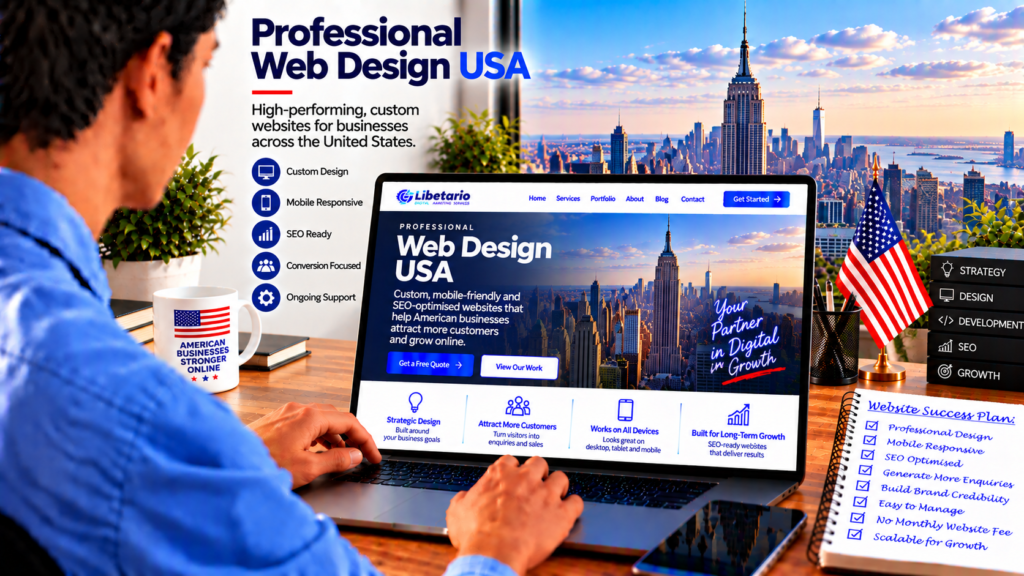
A professional website should do more than make your company look good online.
It should help potential customers understand your business, trust your company and take the next step.
For businesses searching for professional web design in the USA, this distinction matters.
There are millions of websites online, but simply having one doesn’t automatically create business opportunities.
Your website needs a purpose.
For some companies, that purpose is generating quote requests.
For others, it’s selling products, accepting reservations, scheduling consultations, displaying projects or helping customers discover the business through Google.
Whatever the objective, professional web design combines visual quality with usability, performance, search visibility and business strategy.
What Is Professional Web Design?
Professional web design is the process of creating a website around the needs of a business and its customers.
It involves more than selecting colors and arranging images.
A professional website considers:
Brand identity
Customer journey
Page structure
Navigation
Mobile responsiveness
Website speed
Content
SEO
Calls-to-action
Trust
Accessibility
Future growth
Every important design decision should support a reason.
Professional Doesn’t Mean Complicated
Some business owners assume that a professional website needs:
Complex animation
Video everywhere
Dozens of pages
Custom-coded effects
Large interactive elements
That’s not necessarily true.
A clean five-page business website can look more professional than a complicated 50-page website.
Professionalism comes from clarity, consistency and execution.
The website should feel intentional.
First Impressions Matter
Imagine a potential customer receives your company name through a referral.
Before calling you, they search your business online.
They arrive at your website.
What do they see?
An outdated layout?
Broken images?
A site that doesn’t work on mobile?
Old contact information?
Or a clean, modern website that immediately explains what your business does?
The website can reinforce—or weaken—the recommendation that brought them there.
Your Website Represents Your Brand 24/7
Your office may close at 5 PM.
Your website doesn’t.
Customers can research your company:
Early morning
During lunch
At night
On weekends
Your website can continue explaining services and collecting enquiries even when nobody is available to answer the phone.
That makes it an important long-term business asset.
Start With a Clear Homepage
Your homepage should answer three questions quickly:
What do you do?
Who do you serve?
What should the visitor do next?
Suppose you operate an HVAC company in Tampa.
A headline such as:
Professional HVAC Installation & Repair in Tampa, FL
provides immediate clarity.
Follow it with a direct action:
Request a Free Estimate
Customers shouldn’t need to scroll through half the website before understanding your business.
Clear Messaging Beats Clever Messaging
Creative slogans can support branding.
But they shouldn’t replace essential information.
Compare:
Creating Better Experiences for Tomorrow
with:
Commercial & Residential Electrical Services in Miami
The first sounds polished but could describe almost any company.
The second tells the customer exactly what the business provides.
Professional website copy should prioritize clarity.
Professional Website Structure
A typical business website may include:
Home
Introduce the business, primary services and customer value.
About
Explain the company’s story, experience and people.
Services
Present what customers can hire you for.
Projects or Portfolio
Show evidence of previous work.
Contact
Make enquiries easy.
As the website grows, additional pages can support individual services, locations and SEO topics.
Dedicated Service Pages
Important services deserve room.
Suppose a contractor offers:
Kitchen Remodeling
Bathroom Remodeling
Home Additions
Basement Remodeling
Rather than squeezing everything into one page, each service can have its own detailed page.
This allows the business to explain:
The service
Process
Benefits
Previous work
FAQs
Next steps
Dedicated pages can also create better opportunities for search visibility.
Professional Mobile Design
A website isn’t professional if it only looks good on a desktop monitor.
Customers increasingly interact with businesses from smartphones.
Mobile visitors should be able to:
Read
Navigate
Call
Request a quote
Book
Purchase
Complete forms
Buttons should be easy to tap.
Text should be readable.
Menus should be simple.
Responsive design should be standard.
Website Speed Is Part of Professionalism
Customers don’t see your hosting configuration.
They experience the result.
A slow website can create frustration.
Performance problems often come from:
Oversized images
Poor hosting
Heavy video
Too many plugins
Unnecessary scripts
Complex animations
Poor optimization
Professional web design balances appearance and speed.
Optimize Website Images
Images can significantly affect page size.
Professional website development should consider:
Image dimensions
Compression
WebP formatting
Descriptive filenames
ALT text
A photograph doesn’t need to remain at its original camera resolution if it will only appear inside a website section.
Optimization can preserve quality while reducing unnecessary file weight.
Professional Web Design and SEO
Website design and SEO shouldn’t operate completely independently.
Your website structure can affect how easily search engines understand your content.
SEO-friendly foundations may include:
Logical navigation
Clear URLs
Page titles
Heading hierarchy
Internal linking
Mobile responsiveness
Fast performance
Image ALT text
XML sitemap
Indexable content
These don’t guarantee rankings.
But they provide a stronger foundation for future SEO.
Design Pages Around Search Intent
Customers search differently depending on what they need.
Someone searching:
what is web design
is probably researching.
Someone searching:
professional web design USA
may be evaluating providers.
Someone searching:
web designer near me
may be much closer to making contact.
Your website can create content for different stages of this journey.
Professional Web Design for Small Businesses
Small businesses often don’t need enterprise-level complexity.
They need websites that clearly communicate:
What they offer
Why customers should trust them
Where they operate
How customers can contact them
A focused professional website can be extremely effective.
Start with the essentials and expand when there is a genuine business reason.
Professional Web Design for Contractors
Contractor websites should demonstrate capability.
Customers may want to see:
Services
Previous projects
Before-and-after images
Reviews
Service areas
Qualifications where relevant
Quote requests
Real photographs of completed projects can be more convincing than generic marketing claims.
Professional Web Design for HVAC Businesses
HVAC companies can structure their websites around services such as:
AC Installation
AC Repair
Heating
Heat Pumps
Maintenance
Commercial HVAC
These services can then connect to relevant locations.
For example:
HVAC Repair Tampa
AC Installation Miami
Heat Pump Services Orlando
This creates a stronger local SEO structure.
Professional Web Design for Law Firms
Legal websites require credibility and clarity.
Potential clients may be dealing with serious problems.
The website should make it easy to understand:
Practice areas
Attorney experience
Location
Consultation process
Contact options
Professional design should communicate trust without unnecessary visual distractions.
Professional Web Design for Consultants
Consultants often sell expertise rather than physical products.
Their websites should communicate:
Specialization
Experience
Problems solved
Who they work with
Results
Consultation process
Case studies can be particularly valuable.
Professional Web Design for Real Estate
Real estate websites may require:
Property listings
Agent profiles
Search functionality
Featured properties
Neighborhood information
Lead forms
MLS/IDX integration
Requirements vary significantly depending on the business model.
Professional Web Design for Restaurants
Restaurant websites should prioritize the information customers actually want.
Usually:
Menu
Hours
Location
Reservations
Phone
Photos
Ordering where available
Don’t make customers navigate an elaborate animation just to find opening hours.
Professional Web Design for Hotels and Accommodation
Hospitality websites need strong visual presentation.
Potential guests want to see:
Rooms
Facilities
Location
Amenities
Rates
Availability
Reviews
Booking options
Professional photography can have a major impact in this industry.
Professional Ecommerce Web Design
Ecommerce websites have an additional responsibility:
They need to complete transactions.
Professional ecommerce design considers:
Product navigation
Product images
Descriptions
Pricing
Cart
Checkout
Payments
Shipping
Mobile shopping
Every unnecessary obstacle can reduce the likelihood of a completed purchase.
WordPress for Professional Business Websites
WordPress can be suitable for many professional websites.
It can support:
Business sites
Blogs
Ecommerce
Bookings
Portfolios
Landing pages
Memberships
Custom systems
One advantage is flexibility.
A company can start relatively small and expand the website as requirements change.
Professional Design Doesn’t Require Starting From Scratch
Not every website needs to be completely custom-coded.
Professional developers can use established frameworks and platforms efficiently.
The important questions are:
Does the website look professional?
Does it represent the brand?
Does it work properly?
Is it easy to manage?
Can it grow?
Does it achieve the business objective?
Customers care about the final experience more than whether every line of code was created from zero.
Calls-to-Action Matter
Every important page should help visitors understand what to do next.
Examples include:
Get a Quote
Request an Estimate
Book a Consultation
Schedule Service
Call Now
Shop Now
Get Started
Your CTA should match the business objective.
Don’t Overload the Visitor
Professional design involves prioritization.
If every element is large, nothing feels important.
If every button uses a different action, customers may become confused.
Establish:
One primary action
and, where necessary:
One secondary action
Keep the customer journey simple.
Build Trust Throughout the Website
Trust shouldn’t exist only on an About page.
Use genuine credibility signals throughout relevant sections.
Examples include:
Customer testimonials
Google reviews
Case studies
Project photographs
Years of experience
Team members
Certifications
Licenses where relevant
Awards where legitimate
Show customers evidence.
Testimonials Should Be Relevant
Imagine a visitor is reading about bathroom remodeling.
A testimonial discussing bathroom remodeling is more relevant than a generic review.
Place social proof near the service it supports.
This can strengthen credibility at the point where customers are making decisions.
Professional Photography Helps
Authentic images can dramatically improve a business website.
Consider photographing:
Team members
Office
Storefront
Vehicles
Equipment
Completed projects
Products
Facilities
Stock photography can still be useful.
But genuine business images can create stronger authenticity.
Your About Page Matters
Potential customers may want to know who they’re dealing with.
A strong About page can explain:
Company history
Experience
Team
Values
Specialization
Service area
Approach
Avoid generic language that could describe any company.
Tell your actual story.
Your Contact Page Should Be Simple
Don’t create unnecessary barriers.
A contact page may include:
Phone
Contact form
Business hours
Location
Service area
Map where appropriate
If requesting a quote is your primary goal, make that action obvious.
Professional Website Forms
Forms should collect what the business actually needs.
A simple enquiry form may ask:
Name
Phone
Service
Message
A complex form with 25 required fields can discourage potential customers.
Ask only for information that’s genuinely useful at that stage.
Website Accessibility
Professional websites should consider accessibility.
Basic practices may include:
Readable typography
Appropriate contrast
ALT text
Logical headings
Clear form labels
Keyboard accessibility
Descriptive buttons
Accessibility can improve the experience for a broader range of users.
Website Security
Professional websites should use reasonable security practices.
These may include:
HTTPS
Software updates
Strong passwords
Limited administrator access
Backups
Security monitoring
Removing unused software
Security is an ongoing responsibility rather than a one-time setting.
Website Backups
Backups provide a recovery option when problems occur.
Ask:
How frequently is the website backed up?
Where are backups stored?
How long are they retained?
Who can restore them?
The more business-critical the website becomes, the more important backup planning becomes.
Professional Website Maintenance
Websites need maintenance after launch.
Depending on the platform, this can involve:
Software updates
Plugin updates
Backups
Security
Performance
Content changes
Form testing
Technical support
A website shouldn’t be built and then ignored indefinitely.
Analytics and Measurement
Professional websites should support measurement.
Depending on your business, important conversions may include:
Calls
Contact forms
Quote requests
Bookings
Purchases
Consultation requests
Applications
Traffic alone isn’t necessarily success.
The website should support meaningful business outcomes.
Google Search Console
Search Console can help you understand how your website appears in Google Search.
It can provide information about:
Search queries
Clicks
Impressions
Pages
Indexing
This information can guide future SEO improvements and content development.
Professional Web Design and Google Business Profile
Local businesses can use their website alongside Google Business Profile.
A potential customer might discover your business on Maps.
They see:
Reviews
Photos
Phone
Hours
Then visit your website.
The website can provide deeper information about your services and experience.
These assets should support each other.
Local SEO for Professional Websites
Local businesses need relevant visitors—not necessarily visitors from everywhere.
A company in Miami may focus on Miami.
A Tampa contractor may focus on Tampa and nearby service areas.
Your website can communicate:
Services
Locations
This helps customers understand whether you serve them.
Website Ownership
A professionally built website should also have clear ownership arrangements.
Before beginning a project, ask:
Who owns the website?
Who owns the domain?
Who controls hosting?
Will I receive administrator access?
Can I transfer the site?
What happens if I change providers?
These questions should be answered before problems arise.
Understand Ongoing Costs
Professional doesn’t mean the pricing should be confusing.
Ask about:
Development cost
Hosting
Domain renewal
Maintenance
Premium software
Ecommerce fees
Booking software
Other subscriptions
Evaluate long-term cost, not only the initial quote.
How Much Does Professional Web Design Cost in the USA?
There is no universal price.
Cost depends on:
Number of pages
Design requirements
Content
SEO
Ecommerce
Booking functionality
Custom development
Integrations
Hosting
Support
A small informational website and a custom ecommerce system shouldn’t be expected to cost the same.
Affordable Can Still Be Professional
Professional web design doesn’t automatically require a huge budget.
A small business can focus resources on the fundamentals:
Clean design
Strong messaging
Mobile responsiveness
SEO foundations
Fast performance
Clear calls-to-action
Trust signals
Simple management
Avoid paying for complexity that doesn’t support the business.
Remote Professional Web Design
Your web designer doesn’t necessarily need to be located in your city.
Modern projects can be completed remotely through:
Zoom
Messaging
Cloud collaboration
A business in New York can work with a remote design team.
A company in Florida can hire internationally.
What matters is the provider’s ability to understand the market, communicate clearly and deliver quality work.
Professional Web Design Should Be Scalable
Your needs may change.
A website that begins with five pages may later need:
Additional services
New locations
Blog content
Ecommerce
Booking
Customer portals
Custom systems
CRM integrations
Marketing automation
Build on a foundation that can grow with the company.
Frequently Asked Questions
What makes a website look professional?
Professional websites generally use consistent branding, clear typography, intentional spacing, quality imagery, simple navigation and a logical page structure.
How much does professional web design cost in the USA?
Pricing varies according to project size, design, functionality, content, SEO, integrations and support. Compare the complete scope rather than only the initial price.
Does a professional website need custom coding?
Not necessarily. Many professional websites use established platforms such as WordPress while being customized around the business’s branding and requirements.
Should professional web design include SEO?
The website should at least have sound SEO foundations. Competitive ongoing SEO may be a separate service.
Should my business website be mobile-friendly?
Yes. Professional websites should provide a usable experience across smartphones, tablets, laptops and desktops.
Can a professional website generate leads?
A well-planned website can support lead generation through search visibility, clear service information, trust signals and conversion-focused calls-to-action.
Can I hire a web designer outside the USA?
Yes. Website projects can be completed remotely. Communication, experience, quality, technical ability and understanding of the US market are more important than physical location alone.
How often should a professional website be updated?
Technical updates and security maintenance should be handled regularly. Content updates depend on how often your services, offers, projects and SEO strategy change.
Looking for Professional Web Design in the USA?
Libetario has served 200+ clients worldwide since 2017.
We create clean, modern and practical websites for businesses that want to strengthen their online presence.
Our goal isn’t to fill your website with unnecessary features.
It’s to build the right foundation for:
Credibility
Customer enquiries
Search visibility
Business growth
Future expansion
A professional website should represent the quality of the business behind it.
And more importantly, it should help potential customers take the next step.