

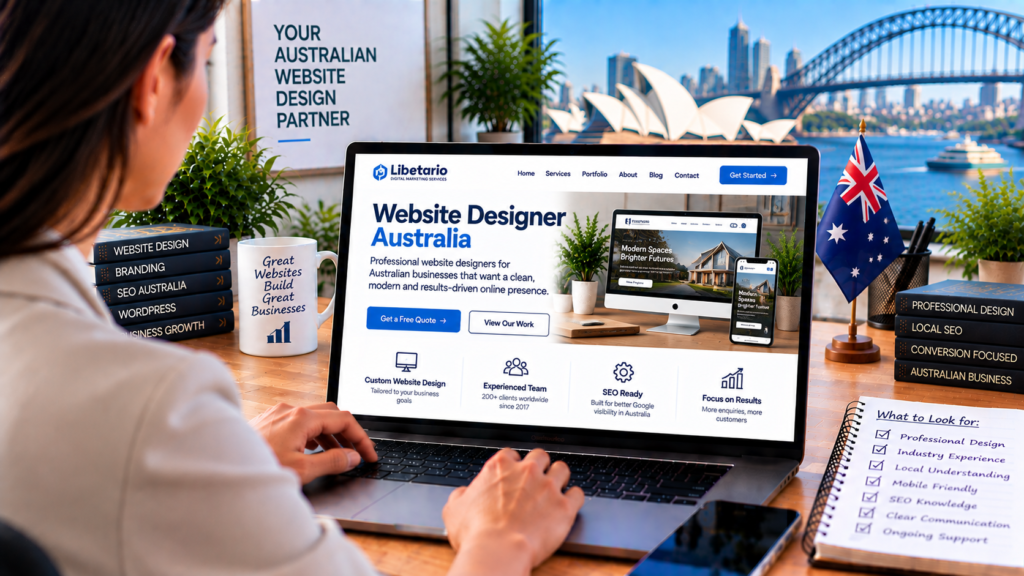
Choosing a website designer can have a significant impact on how your business is presented online.
Your website may be one of the first places potential customers encounter your company. Before calling, requesting a quote or making a purchase, they may use your website to decide whether your business appears credible and capable of helping them.
That’s why choosing a website designer in Australia shouldn’t be based entirely on price or appearance.
A good website designer needs to understand:
Your business
Your customers
Your services
Your goals
Your brand
Your required functionality
The objective isn’t simply to produce attractive pages.
It’s to build a website that supports your business.
Start by Defining What You Actually Need
Before contacting website designers, prepare a basic project outline.
You don’t need a complicated technical document.
Start with simple questions:
What does my business do?
Who are my customers?
What should visitors do on the website?
What pages do I need?
Do I sell products online?
Do I need bookings?
Do I need a blog?
Do I need special integrations?
Do I already have a domain?
Do I already have branding?
This gives the designer something concrete to work with.
Look at the Designer’s Portfolio
A portfolio is one of the first things worth reviewing.
Don’t look only at whether the websites are attractive.
Consider:
Are the designs professional?
Are different businesses given different visual identities?
Do the websites look modern?
Is the text readable?
Are calls to action clear?
Does the work suit the industries represented?
A strong portfolio should demonstrate that the designer can adapt rather than simply reproduce the same layout for every client.
Don’t Choose Based on the Homepage Alone
A designer may show an impressive homepage while giving little attention to the rest of the website.
Ask to see:
Service pages
About pages
Contact pages
Blog layouts
Mobile views
Ecommerce pages
Booking interfaces
A professional website needs consistency throughout—not just an impressive hero section.
Check the Mobile Experience
Open portfolio websites on your phone.
Ask yourself:
Can I read the content comfortably?
Is the menu easy to use?
Are buttons large enough?
Do forms work properly?
Are images correctly sized?
Can I easily call the business?
Mobile design should be part of the project from the beginning.
It shouldn’t feel like the desktop website was simply squeezed onto a smaller screen.
Understand the Designer’s Process
Ask how the project moves from idea to launch.
A typical process might include:
Discovery
↓
Planning
↓
Content Collection
↓
Design
↓
Development
↓
Revisions
↓
Testing
↓
Launch
↓
Support
The exact process varies.
What matters is that you understand what happens and when your input is required.
Ask How Revisions Work
Revisions can become one of the biggest sources of confusion in website projects.
Before beginning, ask:
How many revision rounds are included?
What counts as a revision?
How should feedback be submitted?
What happens if the project scope changes?
What changes cost extra?
There’s an important difference between:
“Please change this section’s background colour.”
and:
“We’ve decided to add an online store, booking system and ten new pages.”
The second request changes the project scope.
A clear revision policy protects both client and designer.
Ask Exactly How Many Pages Are Included
Never assume “business website” means unlimited pages.
A quote might cover:
1 page
5 pages
10 pages
or a completely custom scope.
Get the page list in writing.
For example:
Home
About
Services
Service 1
Service 2
Portfolio
Blog
Contact
If additional pages are requested later, you’ll know whether they fall outside the original scope.
Ask Who Provides the Content
Website content has to come from somewhere.
The project may require:
Business description
Service information
Team profiles
Contact details
Customer reviews
FAQs
Images
Products
Policies
Blog content
Some designers include copywriting.
Others expect the client to provide finished content.
Some provide basic editing but charge separately for professional copywriting.
Clarify this early.
Check Whether SEO Foundations Are Included
If Google visibility matters to your business, ask what the designer means by “SEO.”
Basic website SEO may include:
SEO titles
Meta descriptions
Heading structure
Clean URLs
Image ALT text
Sitemap
Internal links
Mobile usability
Performance basics
But an ongoing SEO campaign is different.
It may include:
Keyword research
Regular content
Technical SEO
Local SEO
Competitor analysis
Authority building
Reporting
Don’t assume website design automatically includes a long-term SEO campaign.
Ask About Website Speed
A visually impressive website can still provide a poor experience if it’s extremely slow.
Ask how the designer handles:
Image optimisation
Caching
Plugins
Video
Scripts
Hosting
Performance
Large images are a common problem.
Images should generally be resized and compressed appropriately for their intended use.
Modern formats such as WebP can help reduce file sizes.
Find Out Which Platform Will Be Used
Your designer may recommend:
WordPress
Shopify
Wix
Squarespace
Webflow
or another platform.
Don’t simply ask:
“Which is best?”
Ask:
“Why is this platform appropriate for my business?”
The recommendation should relate to your requirements.
For example, a business requiring extensive content and WordPress-specific functionality has different needs from a straightforward Shopify ecommerce store.
WordPress Can Be a Strong Option
WordPress can be particularly useful for businesses that want flexibility.
Depending on the project, it can support:
Business websites
Blogs
Ecommerce
Bookings
Memberships
Landing pages
Service pages
Location pages
Custom integrations
However, WordPress also requires proper management.
Ask who handles:
Updates
Backups
Security
Hosting
Plugin licences
Maintenance
Ask About Website Ownership
This is one of the most important questions.
Ask your website designer:
Who owns the finished website?
Who owns the domain?
Who controls hosting?
Will I receive administrator access?
Can the website be transferred?
What happens if I change providers?
What happens if I stop paying for support?
Don’t wait until the relationship ends to discover the answers.
Your Domain Should Be Protected
Your domain can become a valuable business asset.
Make sure you understand:
Where it’s registered
Who controls the account
Who receives renewal notices
When it expires
Whether you can access it
Losing access to a domain can affect your website and business email.
Treat domain access seriously.
Understand Hosting
A website needs hosting unless it is using a hosted platform where hosting is bundled into the service.
Ask:
Where is the website hosted?
Is hosting included?
What does renewal cost?
Are backups included?
Is SSL included?
Can hosting be transferred?
What support is available?
The cheapest hosting isn’t always the best option.
At the same time, most small-business websites don’t require an expensive enterprise server.
Ask About Ongoing Fees
Before signing a website agreement, identify all recurring costs.
These might include:
Hosting
Domain
Premium plugins
Theme licences
Booking software
Ecommerce applications
Maintenance
Security services
Support plans
Email services
Third-party integrations
Ask the designer to separate:
One-time costs
from:
Monthly or annual costs
This makes long-term budgeting easier.
Review Communication Before Hiring
Good communication during the sales process can tell you a lot.
Does the designer:
Answer your questions clearly?
Explain technical concepts understandably?
Respond within reasonable timeframes?
Ask questions about your business?
Provide a clear scope?
Document agreements?
Website projects involve collaboration.
Communication quality matters.
Be Careful With Designers Who Promise Instant Google Rankings
A website designer can build a strong foundation for search.
But nobody controls Google’s organic rankings.
Be cautious of promises such as:
“Guaranteed #1 on Google immediately.”
SEO depends on:
Competition
Content
Search intent
Authority
Technical quality
Links
Local relevance
Time
A professional provider should explain SEO realistically.
Don’t Judge a Designer Only by Price
Suppose you receive three quotes:
Designer A — very inexpensive
Designer B — mid-range
Designer C — significantly more expensive
That alone tells you very little.
Compare what each provider includes.
One quote may include:
Custom design
10 pages
Content assistance
Mobile optimisation
SEO setup
Hosting
Support
while another may include only:
A template
3 pages
No content
No support
The prices aren’t comparable until the scope is comparable.
Cheap Doesn’t Always Mean Bad
A lower-priced designer may have:
Lower overhead
Efficient processes
Remote staff
A different geographic cost base
Standardised packages
That can allow professional work at a lower price.
Evaluate the work and service rather than assuming price alone determines quality.
Expensive Doesn’t Automatically Mean Better
The reverse is also true.
A large agency may have:
Office expenses
Sales staff
Account managers
Larger teams
More complex processes
These can be valuable for certain projects.
But a small business shouldn’t automatically assume the highest quote will deliver the best result.
Choose based on fit.
Local vs Overseas Website Designers
Australian businesses can work with either local or overseas designers.
Local Designer Advantages
Potential benefits may include:
Local market familiarity
Similar working hours
Face-to-face meetings
Local networking
Overseas Designer Advantages
Potential benefits may include:
Different cost structures
Broader provider choice
Extended working-hour coverage
Specialised expertise
Neither is automatically better.
What matters is whether the provider can deliver the required quality, communication and support.
Time Zones Don’t Have to Be a Problem
Remote website projects are common.
If you’re working with a designer in another time zone, establish:
Communication hours
Expected response times
Meeting arrangements
Project-management method
Revision process
Approval process
Good systems can make geographic distance relatively unimportant.
Ask About Support After Launch
Websites continue existing after launch day.
Ask:
How long is post-launch support included?
What does support cover?
Who handles technical problems?
Can I request future changes?
How are additional changes charged?
Who handles updates?
You don’t necessarily need an expensive monthly plan.
But you should know what happens when you need help.
Check Whether Training Is Available
If your team needs to manage the website, ask whether training or guidance is provided.
You may need to learn how to:
Edit text
Change images
Publish blog posts
Add products
Manage orders
Review enquiries
Update basic information
A good CMS can give businesses more control over routine content.
Look for Industry Understanding
A designer doesn’t necessarily need to specialise exclusively in your industry.
But they should understand the customer’s buying journey.
A website for an electrician might prioritise:
Services
Service area
Emergency contact
Reviews
Quote requests
A luxury property business may prioritise:
Photography
Listings
Lifestyle
Trust
Enquiries
An ecommerce store needs an entirely different customer journey.
The designer should adapt accordingly.
Your Website Should Be Designed for Your Customers
Business owners naturally have personal design preferences.
You might prefer:
Blue
Dark backgrounds
Minimalism
Large photographs
That’s useful information.
But the website ultimately needs to communicate effectively with customers.
Design decisions should balance:
Brand
Audience
Usability
Business goals
Accessibility
Conversion
A website isn’t merely decoration.
Check Whether the Designer Understands Calls to Action
Visitors need clear next steps.
Depending on your business, these may include:
Get a Quote
Call Now
Book an Appointment
Shop Now
Schedule a Consultation
Get Started
Make an Enquiry
A designer should understand where and how these actions fit naturally into the customer journey.
Ask About Analytics
Once your website launches, measurement can help you understand performance.
Depending on your setup, analytics may help identify:
Traffic
Popular pages
Traffic sources
Devices
Conversions
User journeys
Ecommerce activity
Ask what tracking will be configured and what additional setup may be required.
Check for Scalability
Your business may change.
Today you might need:
5 pages
Tomorrow you might need:
20 service pages
Multiple locations
Ecommerce
Bookings
Customer accounts
CRM integration
Marketing automation
You don’t need to build all of that immediately.
But ask whether the chosen website can reasonably grow.
Red Flags When Choosing a Website Designer
Be cautious when you encounter:
Unclear pricing
No written scope
No portfolio
No explanation of ownership
Hidden recurring fees
Guaranteed instant rankings
Poor communication
No backup plan
Unclear support
Pressure to purchase unnecessary features
One warning sign doesn’t necessarily mean the provider is unsuitable.
But important questions should have clear answers.
Green Flags to Look For
Positive signs can include:
Clear scope
Transparent pricing
Relevant portfolio
Professional communication
Realistic expectations
Mobile-first thinking
SEO awareness
Clear ownership terms
Defined revision process
Post-launch support
Understanding of your business
The best designer isn’t necessarily the largest company.
It’s the provider who fits your requirements.
Questions to Ask Before Hiring a Website Designer
Before choosing a provider, ask:
How many pages are included?
Which platform will you use?
Why do you recommend it?
Who provides the content?
How many revisions are included?
Is mobile design included?
What SEO setup is included?
Is hosting included?
Are there recurring costs?
Who owns the website?
Will I receive access?
Can the website be transferred?
What support is included?
How long will the project take?
These questions can reveal substantial differences between providers.
Frequently Asked Questions
How do I choose a website designer in Australia?
Review their portfolio, scope, pricing, communication, technical approach, ownership terms, support and experience with websites similar to what your business needs.
Should I choose a local Australian web designer?
A local provider can offer advantages, but businesses can also successfully work with remote or overseas website designers. Quality, communication, capability and project fit are more important than location alone.
What should I provide to a website designer?
Typically, you’ll need business information, branding, services, contact details, images and any specific functionality requirements. Exact requirements depend on the project.
How long does a website take to design?
Timelines vary depending on page count, content availability, functionality, revisions, integrations and project complexity.
Should a website designer provide SEO?
A designer should understand basic search-friendly website structure. Advanced ongoing SEO is usually a separate service, so ask exactly what is included.
Will I own my website?
This depends on the provider’s terms. Ask about ownership, domain control, hosting access, administrator access and transfer rights before beginning the project.
How much does a website designer cost in Australia?
Pricing varies widely depending on the scope, provider, page count, design, content and functionality. Compare detailed project inclusions rather than only the final price.
Looking for a Website Designer for Your Australian Business?
Libetario has served 200+ clients worldwide since 2017.
We create clean, professional websites for businesses that want an online presence built around their services and customers.
Our approach starts with understanding what the business needs rather than adding unnecessary features simply to increase the project scope.
Whether you’re launching a new website, replacing an outdated design or expanding your current online presence, tell us what you’re looking for.
We’ll help you determine the right website solution.